100+ Production-Ready AI Projects, LLM Tutorials, RAG & AI Agents
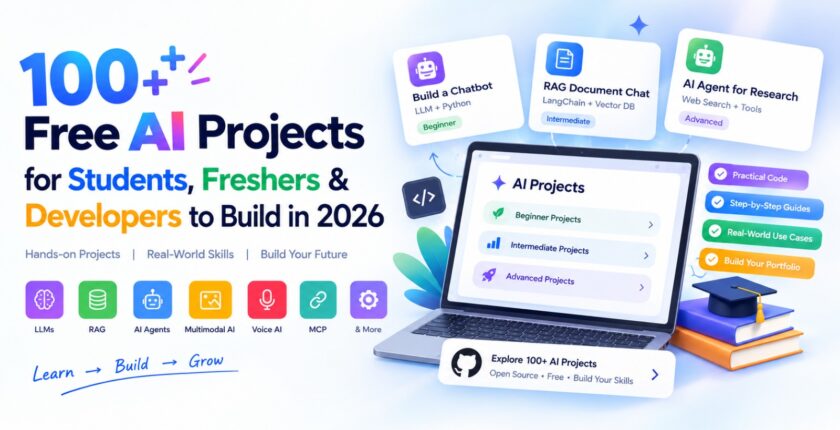
100+ Production-Ready AI Projects : xplore AI Engineering Hub, a GitHub collection of 90+ production-ready AI projects covering LLMs, RAG, AI agents, MCP, multimodal AI, fine-tuning, and real-world applications.
Understanding machine learning algorithms and playing with ChatGPT prompts are no longer the only ways to master AI tech. Large language models, retrieval-augmented generation (RAG), AI agents, multimodal systems, model assessment, MCP, and production deployments are all becoming more and more important to developers. This is where patchy631’s well-known open-source GitHub project, AI Engineering Hub, can be helpful. In order to help developers learn AI engineering by creating actual applications rather than just studying theory, the repository compiles a sizable number of useful tutorials and projects.
There are presently over 93 production-ready projects in the repository, ranging in ability from beginner to advanced. OCR, chat applications, RAG, AI agents, voice applications, multimodal AI, MCP, model comparisons, fine-tuning, deep research, and production systems are among the topics covered by its initiatives. This guide describes how the repository is structured, what you can learn from it, the kinds of projects it contains, and how students and developers may utilize it as a useful roadmap for AI engineering rather than attempting to explain each project separately in a single post.
Also read : Google Adds Gemini AI Voice to Gmail, Docs & Keep: Everything You Need to Know
1. Free AI Projects for Beginners
One of the biggest challenges for students starting their AI journey is knowing what to build. There are thousands of tutorials available online, but many beginners struggle to move from watching tutorials to actually creating applications. This collection provides practical starting points, including OCR applications, local AI chatbots, simple RAG systems, image-generation applications and other relatively accessible projects.
For example, beginners can explore projects involving Llama OCR, Gemma OCR, Qwen OCR, local ChatGPT-style interfaces, streaming AI chatbots and basic document-based RAG. These projects can help learners understand how AI models are connected to applications rather than simply learning AI concepts theoretically.
Explore the complete collection: AI Engineering Hub on GitHub
2. Learn LLM Development Through Real Projects
Large Language Models have become one of the most important areas of modern AI development. However, knowing how to send a prompt to an API is only the beginning. AI developers increasingly need to understand how models are integrated into applications, interfaces, workflows and external tools.
The available projects provide opportunities to experiment with different models and approaches, including local LLM applications, reasoning interfaces and AI-powered chat applications. Candidates can use these implementations to understand concepts such as model interaction, streaming responses, prompt design, user interfaces and application architecture.
3. Build Real-World RAG Applications
Retrieval-Augmented Generation, commonly known as RAG, is another major area covered by these free projects. RAG allows an AI application to retrieve relevant information from external data sources before generating a response, making it particularly useful for documents, websites, databases and private knowledge bases.
The collection progresses from simple RAG implementations to more advanced examples involving GitHub repositories, SQL routing, multimodal data, websites and complex documents. There are also projects involving Agentic RAG, where AI agents can make decisions about retrieval and other actions. This makes the collection useful for candidates who want to move beyond basic chatbot projects and understand how practical AI knowledge systems are designed.
4. Explore AI Agents and Multi-Agent Systems
AI agents are becoming an important part of modern AI engineering because they can go beyond generating text and instead perform tasks using tools, workflows and external information. Learning how agents work can therefore give candidates exposure to a more advanced area of Generative AI.
The project collection includes examples such as agentic RAG, stock-analysis agents, research agents, booking systems, documentation workflows, web-browsing agents and multi-agent applications. These examples can help learners understand concepts such as tool usage, agent memory, planning, workflows and interaction between multiple AI components.
5. Learn MCP, Voice AI and Multimodal AI
Modern AI applications are no longer limited to text-based chatbots. AI systems can now work with audio, images, video, external tools and multiple data sources. This free project collection provides opportunities to explore several of these emerging areas.
Candidates can find projects involving voice bots, audio analysis, video RAG, multimodal RAG and Model Context Protocol (MCP). MCP-focused projects are particularly useful for learners who want to understand how AI agents can interact with tools and external systems. Exploring these projects can help candidates build a broader understanding of the AI application ecosystem.
6. Advanced Projects for AI and ML Developers
Once candidates understand the fundamentals, they can move toward more technically demanding projects. The advanced section includes areas such as model fine-tuning, reasoning-model development, transformer implementation, advanced AI agents, production systems and complex MCP infrastructure.
Projects such as DeepSeek fine-tuning, building a reasoning model and implementing the Transformer architecture from scratch can help learners understand what happens beneath the application layer. Other projects, including advanced research agents and production-oriented document systems, can provide exposure to the engineering challenges involved in building more sophisticated AI solutions.
7. Turn These Projects Into a Strong AI Portfolio
Simply adding a GitHub repository to your resume does not automatically make it a strong portfolio project. The real value comes from understanding the implementation and being able to explain what you built, why you selected a particular architecture and what problems you solved.
Candidates can use these free projects as starting points rather than simply copying them. Pick a project, understand how it works, modify its functionality and add your own features. For example, a basic document chatbot could be extended with authentication, conversation memory, improved retrieval, citations, evaluation or a better user interface. This transforms an existing implementation into a more personalized portfolio project.
8. Use the Projects as a Free AI Learning Roadmap
One of the most useful aspects of the collection is that candidates do not have to randomly select projects. The official repository organizes its projects into beginner, intermediate and advanced levels, with beginner projects covering fundamentals, intermediate projects introducing agents and complex workflows, and advanced projects covering areas such as fine-tuning and production systems.
A student could therefore start with a simple chatbot or RAG project, progress to agentic RAG, then explore MCP, multimodal AI and advanced agent systems. Following this progression can provide a practical learning path while allowing candidates to build projects at each stage of their development.
Why Students Should Use Free AI Projects
For students and freshers, one of the biggest advantages of project-based learning is that it provides something concrete to discuss during interviews. Instead of simply mentioning “Generative AI” or “Machine Learning” on a resume, candidates can demonstrate what they have actually built.
These projects can also help candidates identify which areas of AI interest them most. Someone may discover that they enjoy RAG and knowledge systems, while another person may prefer AI agents, computer vision, voice AI or model development. This makes project-based learning useful not only for skill development but also for choosing a career direction.
How to Get the Most From These AI Projects
Don’t try to complete 100 projects.
That is not the goal.
Instead, choose 3–5 projects that match your career objective. Start with one project that matches your current skill level, understand the codebase, run the project, experiment with it and then make meaningful improvements.
For example:
Beginner: Start with OCR, chatbot or basic RAG.
Generative AI: Focus on RAG, multimodal applications and LLM-based systems.
AI Agent Developer: Explore Agentic RAG, multi-agent systems, MCP and tool-based workflows.
Advanced AI/ML: Explore fine-tuning, reasoning models and transformer implementations.
AI Engineer: Combine RAG, agents, databases, APIs, evaluation and deployment into a complete application.
The goal should be to move from “I followed a project” to “I understand and can build this system myself.”
Where Can You Find These Free AI Projects?
The complete collection is publicly available on GitHub and can be explored for free. It includes tutorials and implementations covering LLMs, RAG, AI agents and other AI engineering topics.
You can explore the complete resource here: Explore the Free AI Projects on GitHub
Final Verdict
For students, freshers and developers trying to enter the AI industry, building practical projects is one of the most effective ways to strengthen technical skills. A collection of 100+ AI projects gives learners plenty of opportunities to experiment with different technologies instead of repeatedly building the same basic chatbot.
The most important thing is not the number of projects you complete. Quality matters more than quantity. Pick projects that match your career goal, understand the underlying concepts, modify the implementation and build your own version.
If you’re learning AI in 2026 and looking for free project ideas, practical implementations and portfolio inspiration, this collection is worth exploring.
Are these AI projects free to use?
The projects are available as a public GitHub resource, so candidates can explore the source code and implementations without paying for access to the repository. Individual projects may have their own dependencies, APIs or infrastructure requirements.
Are these AI projects suitable for beginners?
Yes. The collection includes projects organized across beginner, intermediate and advanced levels. Beginners can start with OCR, chatbot and basic RAG implementations before progressing toward agents and more complex AI systems.
Can I use these projects on my resume?
You can use them as learning and portfolio starting points, but simply copying a project is not recommended. Understand the implementation, make meaningful changes and be prepared to explain the architecture and your contributions during interviews.