Meta Muse: What Is Meta’s New Personal AI Agent? Features, How It Works, Privacy & Future
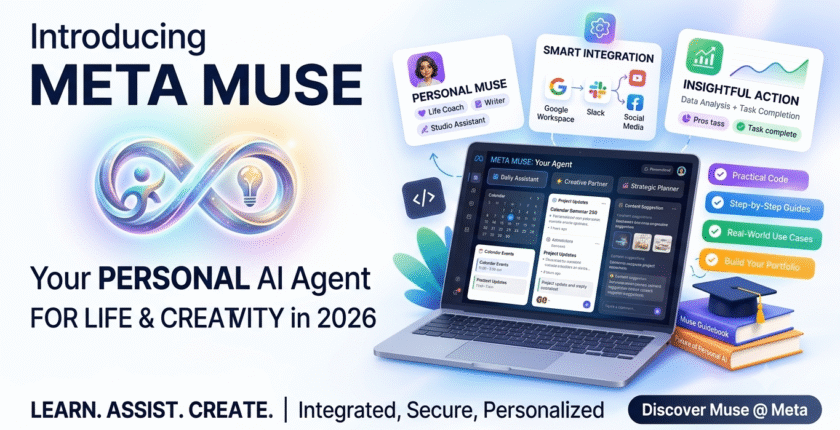
Meta Muse: Meta Muse is a new personal AI agent that can plan, browse, send emails, shop, book travel and complete tasks for users. Learn how Muse works, its features, privacy, security and future.
Muse is a new personal AI assistant from Meta that can do more than just respond to inquiries. Muse, which was unveiled on September 8, 2026, is intended to act on behalf of users, manage chores and projects, collaborate across linked applications, and assist in transforming long-term objectives into workable plans. According to Meta, Muse is positioned as a significant step toward what the firm refers to as “personal superintelligence” because it is designed to be accessible to regular users rather than requiring technical skill.
Meta Muse is built around AI agent capabilities, as contrast to a traditional AI chatbot where users often ask a query and get a response. Before doing sensitive operations like sending an email or making a purchase, it can ask the user for permission, open a browser, complete forms, and work on tasks in the background. According to Meta, Muse will first be available in the US on iOS, Android, and the web before being added to AI glasses.
Also read : 12 Free Google AI Tools Most People Still Don’t Know About in 2026
What Is Meta Muse?
Meta created Meta Muse, a personal AI agent that can comprehend a user’s objectives, schedule tasks, communicate with websites and applications, and act on the user’s behalf. It is intended to advance AI helpers from dialog to action.
For instance, a user might assign Muse a more general duty, like making travel plans, rather than asking an AI, “What are some decent hotels in New York?” Muse can assist in creating a strategy, investigating possibilities, interacting with websites, and carrying on until it reaches a stage when human approval is necessary. According to Meta, Muse can concentrate on longer-term objectives while managing chores like emailing and making trip arrangements.
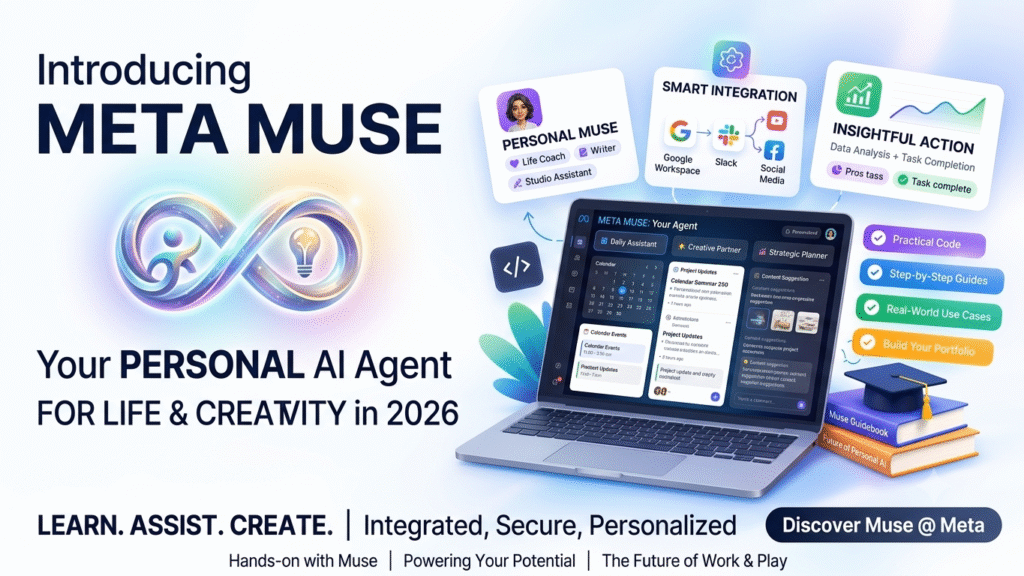
Meta Muse vs Traditional AI Chatbots
Traditional AI chatbots are primarily question-and-answer systems. You provide an instruction, the AI generates a response, and you decide what to do next.
A simplified comparison looks like this:
| Capability | Traditional AI Chatbot | AI Agent Like Muse |
|---|---|---|
| Answer questions | Yes | Yes |
| Generate content | Yes | Yes |
| Plan tasks | Limited/varies | Yes |
| Browse websites | Limited/varies | Yes |
| Fill forms | Generally limited | Yes |
| Work in background | Limited | Yes |
| Connect to applications | Limited/varies | Yes |
| Take actions | Usually limited | Yes, with controls |
| Ask for approval | Sometimes | Designed into workflow |
| Long-term goals | Limited | Core focus |
The important distinction is that Muse is intended to act, not merely respond. Meta explicitly describes the product as a personal AI agent that takes work off the user’s plate.
How Does Meta Muse Work?
Muse Uses an AI Agent Architecture
Muse Spark, Meta’s model family created by Meta Superintelligence Labs, is the core of Muse. In April 2026, Meta unveiled the first Muse Spark, a multimodal reasoning model with multi-agent orchestration and tool usage capabilities.
Later, Meta released Muse Spark 1.1, which it described as a multimodal reasoning model designed especially for agentic tasks with enhancements in multimodal comprehension, computer use, tool use, and coding.
This is significant since language generation alone is not sufficient for an AI agent. It must comprehend a purpose, ascertain the essential procedures, engage with tools, watch what occurs, and modify its activities as needed.
Muse Can Continue Working After You Leave
The fact that Muse may continue working on larger projects even after the user exits the application is one of its most intriguing features. Meta claims that Muse can carry on operating in the background and come back when something changes or when the user needs to provide their consent.
People’s interactions with AI may change as a result.
A user may tell Muse the goal and let the agent take care of a large portion of the procedure rather than spending thirty minutes manually comparing options, filling out forms, and organizing information.
Key Features of Meta Muse
1. Task Automation
Muse’s ability to carry out tasks rather than only deliver information is its main characteristic.
According to Meta, Muse can manage tasks including sending emails, making trip arrangements, completing paperwork, visiting websites, and negotiating on behalf of a user. The system is built to request permission before taking sensitive actions.
This is the primary distinction between an AI agent and an AI assistant. You may learn how to schedule a flight from a chatbot. The goal of an agent is to assist in completing the process.
2. Long-Term Goal Planning
Muse is also designed to work with goals that involve multiple steps.
For example, a user could give Muse a broader objective rather than a single instruction. Meta says Muse can help develop a personalized plan, coordinate time and resources, and advance the work independently.
This could eventually make AI useful for more complicated personal workflows, including travel planning, household tasks, financial administration, shopping research and project organization.
3. Browser and Computer Use
Within its safe computer environment, Muse has access to its own browser.
This implies that the agent may interact with websites and carry out tasks in a manner similar to that of a human computer user. According to Meta, Muse can launch a browser and complete forms.
Because there are millions of websites and services on the internet that may not have specific AI APIs, computer use is a crucial skill for AI agents. Many of them can be interacted with via their current interfaces by an agent that can run a browser.
4. Email and Calendar Integration
Muse is designed to work with applications people already use in everyday life.
According to Meta, users can select the degree of access Muse has and link services like email. For instance, users can decide if Muse can read emails or send messages on their behalf.
Because email and calendar data might contain incredibly personal information, this permission-based method is crucial. Users must have fine-grained control over what an AI agent can see and do.
5. AI Shopping and Payments
Muse can also assist with shopping.
According to Meta, Muse can make transactions using Link by Stripe with a one-time-use card that conceals the user’s actual card information from the agent. Additionally, Shop Pay and 1Password integrations are planned, according to Meta.
For AI agents, this is an important breakthrough since making purchases involves more than just accessing information. The agent is required to communicate with a merchant, manage payment or authentication, and maybe complete an irreversible transaction.
Because of this, Meta has developed permission processes for delicate acts.
6. Memory and Personalization
Another major feature of Muse is its ability to remember information that matters to the user.
Meta says Muse can learn from conversations and remember useful details. For example, Meta gives the example of remembering dietary restrictions when helping organize a dinner party.
Is Meta Muse Available Now?
Yes, but the initial rollout is limited.
On September 8, 2026, Meta said that Muse would be available on iOS, Android, and muse.ai in the US. Muse is coming to AI glasses, according to Meta.
According to Meta, Muse will be free for the majority of users’ needs, with subscription plans available for those who wish to do more. Not all of the company’s capabilities are advertized as being available for unlimited free use.
As Meta grows the service, availability in other nations should be examined.
Meta Muse vs ChatGPT, Gemini and Other AI Agents
The AI assistant market is moving from simple chatbots toward agentic AI.
A growing number of tools for research, coding, browsing, planning, and computer use have been introduced by ChatGPT, Gemini, and other cutting-edge AI platforms. One significant difference in Meta’s approach is that Muse is intended to be a very personal agent that is linked to the services and apps that people use on a daily basis.
With its extensive product ecosystem, which includes Facebook, Instagram, WhatsApp, Messenger, and AI glasses, Meta is also in a unique position to distribute an AI assistant. The company has already been extending these products’ Muse Spark-powered features.
As a result, the main rivalry could involve more than just which chatbot provides the best response.
The ability of an AI agent to comprehend your context, access your tools, finish tasks consistently, and gain enough trust to act on your behalf could turn into a competition.
What is Meta Muse?
Meta Muse is a personal AI agent from Meta designed to understand goals, plan tasks, interact with websites and applications, and perform actions on behalf of users.
Is Meta Muse free?
Meta says Muse is free for most things users need, with subscription plans planned for people who want to do more. Availability and capabilities can vary by rollout.
What can Meta Muse do?
Muse can perform tasks such as browsing websites, filling forms, sending emails, planning activities and booking travel. It can also work on longer tasks in the background and request approval before sensitive actions.