OpenAI Just Launched GPT-6 Astra: What It Can Do and Why It Matters
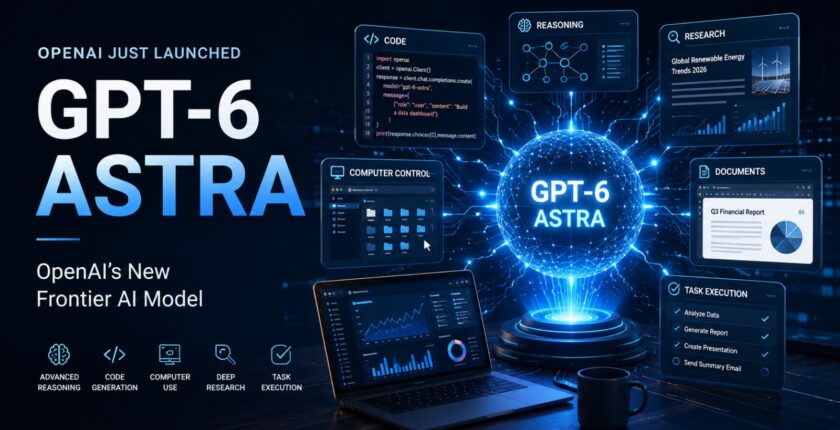
OpenAI Just Launched GPT-6 Astra : OpenAI has officially launched GPT-6 Astra, its newest frontier AI model, marking another major step in the rapid evolution of artificial intelligence. Announced on September 3, 2026, GPT-6 Astra is designed to go beyond traditional chatbot interactions by handling complex reasoning, coding, research, computer use, document creation, and other multi-step professional tasks. OpenAI describes Astra as its most intelligent and aligned model yet, with capabilities designed for real-world work rather than simply generating answers to individual prompts.
The GPT-6 Astra launch is especially noteworthy because it focuses on AI that can really do tasks. Astra is made to interact with computers, use software, browse information, write and test code, produce documents, and finish workflows rather than asking an AI to explain how to accomplish a task and then doing it yourself. This has also sparked a much larger debate about Artificial General Intelligence (AGI) and whether the industry is getting closer to that objective as AI agents get more skilled. But rather than being seen as unquestionable evidence that AGI has been accomplished, the launch should be seen as a significant step toward more universal and autonomous AI.
What Is GPT-6 Astra?
The most recent general-purpose frontier AI model from OpenAI, GPT-6 Astra, is designed for intricate end-to-end tasks. It is intended to integrate sophisticated thinking with computer interaction, coding, research, document generation, and multi-step task execution. Astra is prepared for some of the most challenging tasks, such as complicated thinking, software engineering, computer use, research, and professional knowledge job, according to OpenAI’s developer documentation.
The key distinction is that Astra isn’t being marketed as just another model that generates better text. Its features are designed to finish workflows that call for several steps. When a user sets a goal, the model may be able to organize the necessary actions, make use of the instruments at hand, communicate with software, assess the outcomes, and carry on. This brings AI closer to an agentic workflow, in which the system is supposed to achieve a goal rather than just answer a query.
GPT-6 Astra Can Use Computers
Computer use is one of the most significant features added with GPT-6 Astra. According to OpenAI, Astra is capable of interacting with computer environments and carrying out tasks including filling out forms, doing online research, updating CRM data, setting up calendars, building websites, and using software.
The way people utilize AI helpers could be drastically altered by this. Traditionally, a person does the real computer work while an AI chatbot gives directions. The workflow can become much more straightforward with computer-use capabilities: the user sets an aim, the AI decides on the stages, communicates with the pertinent applications, and works to finish the activity. For this reason, GPT-6 Astra is being considered as part of the shift from conversational AI to action-capable AI agents.
Also Read : How to Use Claude AI to Find 20+ Job Openings in Just 2 Minutes
3. GPT-6 Astra Brings Advanced Coding Capabilities
Another important area where GPT-6 Astra is anticipated to have a big influence is coding. Astra, which is intended to manage intricate development jobs and extended processes, is OpenAI’s strongest software-engineering model to date.
Developers can employ increasingly sophisticated AI systems for more comprehensive development workflows rather than relying just on AI to provide specific functionality or clarify programming ideas. Writing code, testing software, finding issues, debugging, and iterating on implementations are all tasks that Astra can help with. Additionally, OpenAI has provided instances of how Astra was applied to real-world software and product development processes. This implies that human goal-setting may become more prevalent in AI-assisted programming in the future, with AI systems handling more of the implementation and testing.
4. GPT-6 Astra Is Designed for Complex Multi-Step Work
Long-term and multi-step work is one of the launch’s main themes. A lot of conventional AI interactions are quite straightforward: pose a query, get a response, and proceed. Astra is intended for jobs when accomplishing the goal necessitates a number of related steps.
A complex activity can, for instance, involve gathering data, evaluating several sources, producing a spreadsheet, drafting a report, reviewing the findings, and making adjustments. Instead of requiring the user to manually guide each step, an agentic model may be able to coordinate these steps. Because many professional processes involve repetitive digital operations dispersed across several programs, this is especially crucial for organisations. AI’s potential productivity benefit increases with how consistently it can carry out certain tasks.
5. GPT-6 Astra Is Built for Research and Professional Work
Additionally, GPT-6 Astra is made for knowledge-intensive professional jobs and sophisticated research. Research, science, coding, documentation, and other professional applications are among the areas in which OpenAI excels.
Professionals who frequently deal with vast amounts of data may find Astra helpful as a result. AI could be used by researchers to study complicated subjects, by analysts to process data and create reports, and by business teams to automate certain processes. The general trend is evident: AI is evolving from content creation to systems that can take part in the entire knowledge-work process.
6. GPT-6 Astra Shows Strong Benchmark Performance
Astra’s purported performance on challenging AI benchmarks is another reason the launch has garnered notice. In a variety of domains, such as reasoning, coding, computer use, and other complex assessments, OpenAI has demonstrated impressive performance. Additionally, state-of-the-art findings for GPT-6 Astra on ARC-AGI-3 have been reported by the ARC Prize organization.
Benchmark findings should be viewed cautiously, though. An AI system does not necessarily have human-level general intelligence in all contexts just because it has a high benchmark score. Real-world reliability can differ significantly from controlled tests, and different standards measure different capabilities. Because of this, rather than providing conclusive evidence of AGI, Astra’s benchmark performance is best seen as evidence of notable capacity gains.
7. Is GPT-6 Astra the Beginning of AGI?
This is arguably the biggest question surrounding the launch: Is GPT-6 Astra AGI?
The answer depends heavily on how AGI is defined. Artificial General Intelligence generally refers to AI capable of performing a broad range of intellectual tasks with a level of flexibility and generality comparable to humans. OpenAI and industry leaders have increasingly focused on systems that can reason, use tools, operate computers and perform economically valuable work. Some reporting around the Astra launch has described it as potentially marking the beginning of the AGI era.
But it is important not to confuse highly capable agentic AI with a universally accepted definition of AGI. GPT-6 Astra clearly represents a major step toward more autonomous and general-purpose AI, but questions remain around reliability, adaptability, human-level generality, autonomy and safety. Therefore, the most accurate description is that Astra could represent an important milestone on the path toward AGI rather than treating the launch itself as an unquestionable AGI declaration.
8. GPT-6 Astra Could Change the Future of Work
The growing sophistication of AI agents may significantly alter the way people work. Rather than merely assisting employees with writing emails or summarizing documents, systems like Astra might soon handle entire digital workflows. Developers, marketers, researchers, analysts, recruiters, customer-service teams, and other professionals could assign parts of their tasks to AI agents.
This does n’t necessarily mean that AI will instantly replace whole professions. In the near term, a more realistic shift is that individual tasks within jobs will see greater automation. Human workers may devote less time to repetitive digital tasks and instead focus more on setting goals, reviewing work produced by AI, making decisions, and managing situations that demand judgment.
9. GPT-6 Astra Also Raises Important AI Safety Questions
This is significant because an AI system able to identify vulnerabilities, control computers, and carry out complex tasks could potentially serve both defensive and harmful purposes. More autonomous systems also raise concerns regarding oversight, reliability, privacy, and unintended consequences. Therefore, OpenAI has highlighted safeguards and monitoring in addition to Astra’s capabilities. The key challenge for the industry will be striking the right balancegranting AI sufficient autonomy to be effective while ensuring meaningful human oversight remains in place.
10. Why GPT-6 Astra Matters for the Future of AI
The biggest significance of GPT-6 Astra may not be one individual feature. It is the combination of reasoning + tools + computer use + coding + research + multi-step execution.
For years, the dominant AI interaction has looked like this:
Human asks → AI answers → Human acts.
The emerging agentic model looks more like:
Human gives goal → AI plans → AI uses tools → AI performs actions → AI checks results → AI delivers outcome.
That difference could define the next phase of artificial intelligence. Microsoft has similarly described the emerging enterprise AI landscape as moving beyond chat experiences toward models that can work across applications and systems where businesses operate.
Conclusion
OpenAI’s GPT-6 Astra represents more than just another chatbot upgrade. It marks a major step forward in developing AI systems capable of reasoning through complex problems, using computers, writing and testing software, conducting research, and carrying out multi-step workflows. Its release has also heightened discussions over whether the AI industry is stepping into an early AGI phase.
Whether GPT-6 Astra is ultimately considered AGI will hinge on its real-world performance and the definition of AGI itself. It’s already evident that the line separating an AI designed to answer questions from one that performs tasks is growing increasingly indistinct.
For users, developers and businesses, the most important question may no longer be simply, “What can AI tell me?” It may soon become:
“What can AI actually do for me?”
And GPT-6 Astra is one of the clearest examples yet of how quickly that future is arriving.
What is GPT-6 Astra?
GPT-6 Astra is OpenAI’s latest frontier AI model, designed for advanced reasoning, coding, research, computer use, and complex multi-step tasks. Unlike traditional chatbots that primarily provide answers, GPT-6 Astra is designed to help execute real-world digital workflows.
What can GPT-6 Astra do?
GPT-6 Astra can assist with complex reasoning, software development, research, computer-based tasks, document creation, and other professional workflows. Its computer-use capabilities allow it to interact with software and perform actions rather than simply explaining how a user should complete them.
Is GPT-6 Astra the same as AGI?
GPT-6 Astra represents a significant advancement toward more general and autonomous AI, but calling it definitive AGI depends on how Artificial General Intelligence is defined. Its broad capabilities make it an important milestone in AI development, but the launch itself does not establish universal agreement that AGI has been achieved.