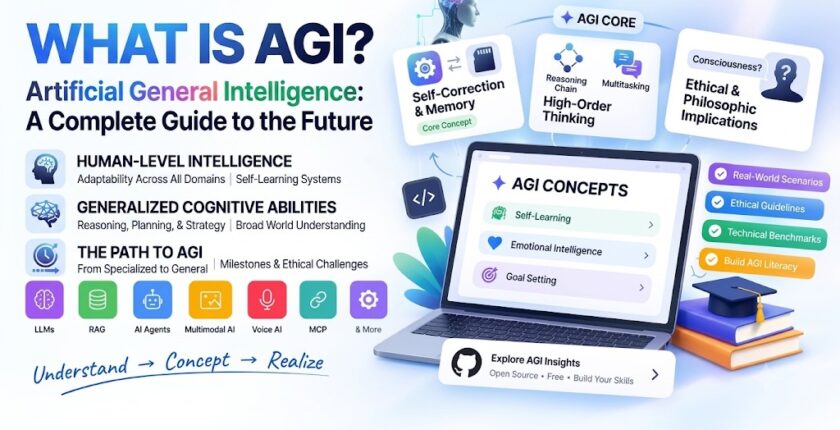
What Is AGI? Understanding Artificial General Intelligence, How It Works, Benefits, Risks & Future
What Is AGI? : Learn how Artificial General Intelligence works, how it differs from AI, its potential benefits, risks, applications, and future impact.
One of the most talked-about ideas in artificial intelligence is artificial general intelligence, or AGI. AGI is a potential kind of artificial intelligence that might comprehend, learn, reason, adapt, and solve a wide range of issues at a human-like level, in contrast to today’s AI systems, which are often made to do specific jobs. To put it simply, artificial general intelligence (AGI) seeks to build robots that are capable of applying intelligence in a wide range of contexts rather than just one specific activity.
Because of its potentially revolutionary potential, the concept of AGI has drawn a lot of interest from academics, tech firms, developers, companies, and legislators. Theoretically, an AGI system could tackle unexpected challenges, transfer knowledge between different areas, and learn new talents without being specifically programmed for every task. However, there is still much disagreement over what qualities should make an AI system really universal intelligence, and AGI has not yet been proven.
What Is AGI?
Artificial General Intelligence, or AGI, is a hypothetical kind of artificial intelligence that is not restricted to a single purpose but is capable of carrying out a wide range of intellectual tasks. The ideal AGI system would be able to apply knowledge from one field to another, learn from experience, comprehend many kinds of information, reason through difficult problems, and adapt to novel circumstances.
The majority of AI applications on the market today are classified as specialized or narrow AI. An AI system might be very good at creating text, identifying pictures, making product recommendations, interpreting languages, or playing games, for instance. The development of an AI system with adaptable, general-purpose intelligence that can function in a variety of fields is the larger objective of AGI.
How Is AGI Different From Traditional AI?
Conventional AI systems are often designed to carry out certain tasks or sets of related tasks. While an image recognition system can identify items in photos, a recommendation engine might examine user behavior to provide product recommendations. Although generative AI models are capable of producing text, images, music, video, and code, their capabilities are still contingent upon their operating environment, tools, architecture, and training.
In comparison, AGI is meant to be far more adaptable. An AGI system would potentially be able to learn and carry out a wide range of tasks, eliminating the need for separate systems for different kinds of issues. For instance, the same system might be able to comprehend a new topic, design a corporate strategy, learn a new programming language, study a scientific problem, and modify its approach when conditions change.
AGI vs AI at a Glance
| Feature | Traditional/Narrow AI | AGI |
|---|---|---|
| Primary purpose | Specific tasks | General-purpose intelligence |
| Adaptability | Usually limited | Expected to be broad |
| Learning | Defined by training/design | Expected to learn across domains |
| Problem-solving | Domain-specific | Cross-domain |
| Transfer of knowledge | Limited | Expected to be strong |
| Status | Widely deployed | Not definitively achieved |
What Are the Main Characteristics of AGI?
One of the main characteristics of AGI is generalization. A really general intellect shouldn’t merely memorize solutions to problems pertaining to training. Instead, it must be able to understand new situations and apply previously learned information to new problems. This ability to transmit knowledge is considered to be one of the main distinctions between general intelligence and specialized AI.
Another essential trait is adaptability. An AGI system should ideally be able to learn new skills with minimal additional training. It is possible to integrate reasoning, language understanding, perception, planning, learning, and decision-making. Since there isn’t a single, accepted checklist that defines AGI, academics and tech companies may utilize a variety of factors when discussing whether a system is approaching general intelligence.
Also read this : 100+ Production-Ready AI Projects, LLM Tutorials, RAG & AI Agents
Key AGI Characteristics
- General-purpose learning
- Reasoning and problem-solving
- Adaptation to unfamiliar situations
- Knowledge transfer between domains
- Understanding of complex instructions
- Long-term planning
- Multimodal understanding
- Autonomous learning and improvement
3. How Could AGI Work?
Since there is currently no widely recognized AGI architecture, the precise technological design of AGI is still uncertain. Large-scale machine learning, foundation models, reinforcement learning, multimodal systems, reasoning strategies, memory, tool use, planning, and agentic AI are all being investigated by researchers. Combining these features into systems that are capable of doing a far greater variety of tasks is the aim.
Instead than depending just on one model, a hypothetical AGI system might incorporate multiple components. It may, for instance, employ perception to comprehend its surroundings, memory to store pertinent information, reasoning mechanisms to assess issues, planning systems to decide what to do, and external tools to communicate with software or physical settings.
A Simplified AGI Process
Input → Understanding → Reasoning → Planning → Action → Feedback → Learning
This represents a simplified conceptual model rather than a confirmed blueprint for building AGI.
4. What Could AGI Be Used For?
Since general-purpose intelligence is at the heart of AGI, its potential uses are incredibly wide. A sophisticated general AI system might be used in education to create learning programs, provide individualized tutoring, explain difficult subjects at various levels, and modify explanations in response to a student’s success. Such tools could help scientists analyze massive datasets, formulate ideas, assess literature, and investigate potential solutions to challenging issues.
Research, software development, customer service, data analysis, operations, strategic planning, and automation are further areas where businesses might employ AGI. Although high-stakes applications would need strict validation, oversight, privacy safeguards, and regulatory constraints, improved AI might help healthcare practitioners with research and decision assistance.
Potential AGI Applications
- Scientific research
- Education and personalized learning
- Software development
- Business analysis
- Robotics
- Healthcare research
- Engineering
- Financial analysis
- Climate and environmental research
- Complex automation
5. What Are the Potential Benefits of AGI?
Automating complicated intellectual tasks that currently take a lot of human effort is one possible advantage of AGI. A system might boost efficiency in a variety of industries if it could consistently comprehend goals, pick up new duties, reason about strange issues, and make use of the right instruments. Theoretically, businesses may employ more general systems that can adjust to various processes rather than developing a unique AI system for each activity.
Additionally, AGI might speed up technical and scientific development. A highly skilled general intelligence might be able to originate and test hypotheses, evaluate vast amounts of data, find connections across several fields, and help researchers with challenging issues. These skills could benefit fields including medical, materials science, energy, engineering, and environmental research if they are developed wisely and properly.
6. What Are the Risks and Challenges of AGI?
There are serious concerns associated with the potential advantages of AGI. AI alignment, which generally refers to making sure that extremely powerful AI systems act in accordance with specified goals, limits, and human values, is one significant difficulty. It is crucial to make sure that AI systems’ activities are predictable, controllable, and advantageous as they get more powerful and independent.
Additionally, there are more general social and economic issues. Highly proficient AI has the potential to significantly disrupt labor markets, change the nature of many occupations, modify business models, and raise the value of particular abilities. Misinformation, cybersecurity, privacy, technical power concentration, independent decision-making, and misuse are further issues. Due to these difficulties, the creation of AGI is not just a technical issue but also one that encompasses public policy, economics, law, governance, and ethics.
Major AGI Concerns
- AI alignment
- Loss of human control
- Job displacement
- Economic inequality
- Misinformation
- Cybersecurity threats
- Privacy concerns
- Concentration of AI capabilities
- Autonomous decision-making
- Governance and regulation
7. AGI vs Generative AI: What Is the Difference?
AI systems that are capable of producing new text, images, music, video, software code, and other types of digital output are referred to as generative AI. Many jobs that previously required specialized software or human labor can now be completed by modern generative AI, which has shown outstanding capabilities. But a system does not necessarily qualify as AGI just because it is very good at many tasks.
AGI is a more comprehensive idea that emphasizes adaptability and general intelligence. The question of whether a generative AI model has the kind of strong general reasoning, learning, autonomy, and transfer skills associated with AGI is still unanswered, even though it might be able to write an article, summarize a document, generate code, or analyze an image. As a result, generative AI and AGI shouldn’t be used interchangeably.
Simple Example
Generative AI:
“Write Python code that analyzes this dataset.”
Conceptual AGI:
“Understand this new business problem, determine what information is needed, learn the relevant concepts, choose appropriate tools, develop a solution, evaluate the results, and adapt the approach if it fails.”
The second example describes the broader idea of general-purpose intelligence rather than a specific currently established capability.
8. When Will AGI Be Achieved?
As of right now, there is no widely acknowledged timeline for the development of AGI. Because academics cannot agree upon a single definition or benchmark for AGI, predictions differ significantly. While some experts contend that significant scientific and engineering advancements may still be necessary, others think that advances in AI could lead to increasingly generic systems rather soon.
Additionally, it’s critical to differentiate between independently verified evidence of AGI and marketing claims about sophisticated AI systems. A system may exhibit remarkable capabilities or perform very well on benchmarks without necessarily meeting every definition of general intelligence that has been put forward. The definition, assessment, and governance of AGI will probably continue to be important topics of study and public discourse as AI advances.
The Future of AGI
Although AGI’s future is uncertain, the idea is already affecting how artificial intelligence research is conducted. The larger endeavor to create increasingly powerful and flexible AI systems is being aided by recent advancements in foundation models, multimodal AI, AI agents, robotics, reasoning systems, memory, and tool-using models.
The fundamental questions are crucial now, regardless of whether AGI appears in the near future, decades from now, or turns out to be more challenging than anticipated. How should highly competent AI systems be assessed? What protections ought to be mandated? How could educational institutions and employees get ready? And how can the advantages of cutting-edge AI be fairly dispersed? As AI capabilities continue to advance, these considerations will become more crucial.
Conclusion
Artificial General Intelligence, or AGI, is a speculative type of AI that is not limited to a specific field but can learn, reason, adapt, and carry out a wide range of intellectual tasks. AGI seeks to provide more general-purpose intelligence and the capacity to transfer information between various issue kinds, in contrast to classical AI systems built for specific applications.
AGI has immense promise, even if it is still an open research objective rather than a widely accepted achieved technology. It has the potential to revolutionize a wide range of industries, including education, science, software development, healthcare, business, and robotics. AGI also poses significant challenges to human control, safety, employment, governance, privacy, and security. As the world advances toward increasingly powerful artificial intelligence, it is critical to comprehend these potential and challenges.
What does AGI stand for?
AGI stands for Artificial General Intelligence. It refers to the concept of an AI system capable of performing and learning a broad range of intellectual tasks rather than being limited to a specific function.
Is AGI available today?
There is no universally accepted evidence that AGI has been achieved. Current AI systems can perform many impressive tasks, but whether any existing system meets a robust definition of artificial general intelligence remains debated.
What is the difference between AI and AGI?
AI is a broad term covering technologies that perform tasks associated with intelligence, while AGI specifically refers to the goal of creating a system with broad, adaptable, general-purpose intelligence.