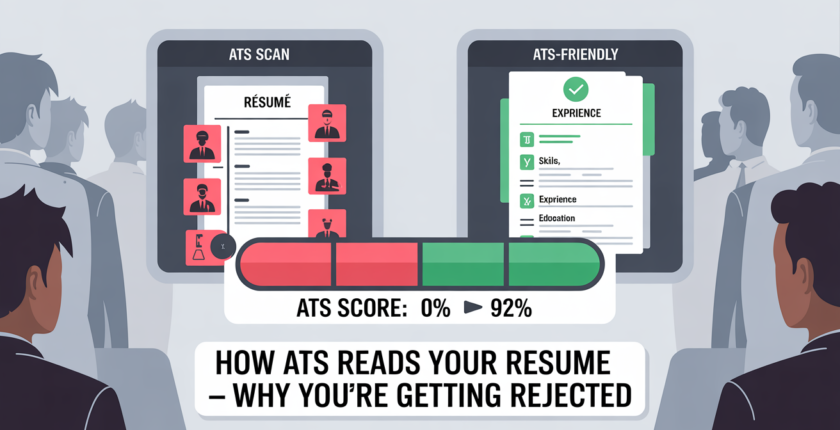
How ATS Actually Reads Your Résumé (And Why You’re Getting Rejected in 2025)
How ATS Actually Reads Your Résumé : The majority of job searchers think that an Applicant Tracking System (ATS) is an intelligent artificial intelligence (AI) that assesses talent, potential, creativity, and passion. Many believe it honors effort, understands context, or values a growing mentality. Regretfully, one of the main causes of resumes being silently rejected—that is, without receiving a response, an explanation, or a chance to speak with a recruiter—is this belief.
The truth is harsher and far simpler. ATS is not an intuitive or sentimental system. It doesn’t evaluate your level of enthusiasm, desire for the position, or learning speed. It is a rule-based matching engine that only considers structure, keywords, and relevancy when filtering, parsing, and ranking resumes. Regardless of how qualified you are, you will be rejected if your resume does not follow its logic.
After seeing several actual recruiting drives and chatting with over 20 HR recruiters, a certain pattern becomes apparent: the majority of candidates are not underqualified, but rather under-optimized for applicant tracking systems. This article discusses why your resume can be rejected and provides a step-by-step breakdown of how applicant tracking systems operate.
ATS Parses Your Résumé Before Any Human Sees It
Your resume is initially converted to plain text by an applicant tracking system. We refer to this process as parsing. The system looks for categories like employment experience, talents, education, and certifications during processing. Everything that follows is meaningless if the system is unable to read or comprehend the format of your resume.
At this point, a lot of resumes fail due to design decisions designed to “stand out.” ATS software is confused by tables, multi-column layouts, icons, graphics, logos, headers, footers, and fancy fonts. The parser either misplaces information or ignores it entirely when it is unable to correctly identify your content. Even if your qualifications are flawless, your CV score may decrease to zero in some situations.
It’s shockingly easy to figure out what works. ATS systems can reliably interpret text thanks to a single-column layout, conventional headings like “Experience,” “Skills,” and “Education,” and understandable fonts like Calibri, Arial, or Times New Roman. Readability is further enhanced by saving your resume as an ATS-compatible PDF or DOCX format. ATS will never be able to rank you fairly if it is unable to correctly read your resume.
Best Student Resume Templates by Novorésumé to Land Jobs Faster in the AI Hiring Era
Keyword Matching Determines 70–80% of Your Score
Once your resume is parsed, the ATS moves to keyword matching — the most critical stage of the entire screening process. Around 70 to 80 percent of your ATS score is determined by how well your resume keywords match the job description.
ATS systems scan resumes line by line to find exact skill names, tools, technologies, certifications, and role-specific phrases mentioned in the job description. This is why generic language hurts your chances. For example, if the job description mentions “SQL, dashboards, and stakeholder reporting,” but your resume only says “worked with databases,” the ATS does not consider it a match.
Keyword matching is not about stuffing buzzwords. It is about using the same language as the job description — truthfully and contextually. ATS systems are literal. If the exact term is missing, the system assumes the skill is missing. Candidates who tailor their resumes using job-specific keywords dramatically improve their chances of moving forward.
ATS Ranks Candidates — It Doesn’t Reject Them
One of the most misunderstood aspects of ATS is rejection. In most cases, ATS does not reject resumes outright — it ranks them. Every resume that passes parsing and keyword matching is scored and placed in a ranked list.
This ranking is based on multiple factors: relevance of skills, recency of experience, job title similarity, and alignment with required years of experience. A candidate might be ranked #47 out of 300 applicants — not because they are unqualified, but because others matched the job description more closely.
Recruiters rarely review all resumes. Typically, they only view the top 10–15 profiles. If your resume is ranked outside that range, it is effectively invisible. This is why candidates often hear nothing back — their resumes were not rejected; they were simply never seen.
Common ATS Mistakes That Cost Candidates Interviews
One of the biggest mistakes candidates make is using one resume for all job applications. ATS systems are job-specific, and a generic resume rarely ranks well. Missing core job description keywords, using creative section titles like “My Journey” instead of “Experience,” and uploading files with unprofessional names such as “Resume_Final_FINAL_v3.pdf” further reduce your chances.
Another costly mistake is writing only responsibilities instead of outcomes. ATS systems favor resumes that show impact and results. Statements without metrics fail to demonstrate relevance. Even experienced professionals lose opportunities because their resumes describe duties instead of achievements.
These mistakes are especially common among freshers, who focus on design rather than structure, and among experienced professionals, who assume their experience alone is enough. In reality, ATS optimization is equally important at every career stage
Take resume review sessions Regularly : Click here
What Actually Works in an ATS-Driven Hiring Process
Successful candidates treat their resume as a technical document, not a creative one. They tailor their resume for every role, mirror job description keywords naturally, and maintain a clear, structured skills section. Quantifying achievements — using numbers, percentages, and measurable outcomes — significantly improves ATS relevance scores.
File naming also matters more than most candidates realize. Using a clean, professional file name like “YourName_Role_Company.pdf” improves credibility and organization for recruiters. While ATS may not score file names heavily, recruiters notice professionalism when resumes reach them.
The most important takeaway is this: ATS optimization does not reduce authenticity — it increases visibility. You are not changing who you are; you are presenting your skills in a language the system understands.
Why You’re Not Underqualified — Just ATS-Unprepared
Many candidates internalize rejection as personal failure. They assume they lack skills, experience, or intelligence. However, in most cases, rejection happens before a human ever evaluates their profile. ATS filters resumes mechanically, without context or emotion.
Understanding how ATS works empowers candidates to take control of their job search. When your resume is structured correctly, aligned with job descriptions, and optimized for ATS logic, your chances of reaching recruiters increase dramatically. Talent alone is not enough in today’s hiring market — visibility is everything.
Why Referrals Are the Most effective Way to start Your Career in 2026
Final Thoughts
Applicant Tracking Systems are not villains, but they are unforgiving. They reward structure, relevance, and precision. Candidates who understand ATS logic stop blaming themselves and start optimizing their resumes strategically.
If your resume keeps getting rejected, the problem is likely not your ability — it is your formatting, keywords, or alignment with ATS rules. Fix those, and the same resume can suddenly start generating interview calls.
In today’s competitive job market, being ATS-qualified is just as important as being job-qualified. Once you master that balance, you stop getting rejected silently — and start getting noticed.