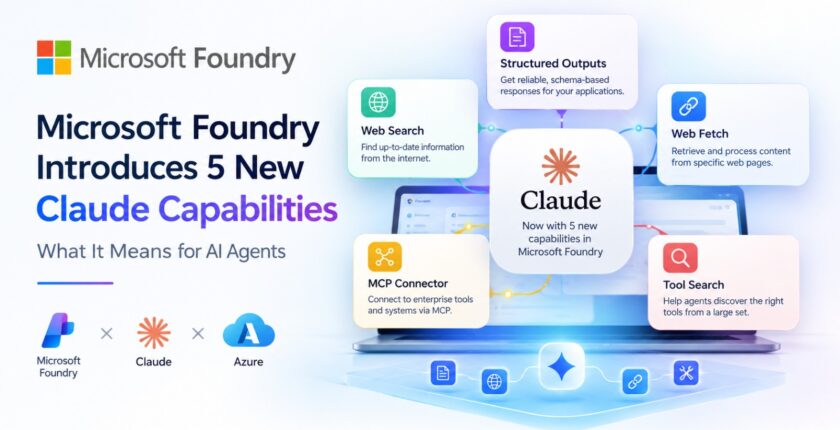
Microsoft Foundry Introduces 5 New Claude Capabilities : What It Means for AI Agents
Microsoft Foundry Introduces 5 New Claude Capabilities : Microsoft Foundry has introduced five new Claude capabilities—Structured Outputs, Web Search, Web Fetch, MCP Connector, and Tool Search—to help developers build more reliable and capable AI agents.
AI development is rapidly moving beyond simple chatbot experiences. Instead of only generating answers from a prompt, modern AI applications increasingly need to search for information, interact with external tools, retrieve online content, process structured data, and perform multiple steps independently. Microsoft is responding to this shift with five new Claude capabilities in Microsoft Foundry: Structured Outputs, Web Search, Web Fetch, MCP Connector, and Tool Search. These features are now available for Claude models hosted on Azure through Microsoft Foundry.
The update is significant because developers traditionally had to build much of this supporting infrastructure themselves. A team might need a custom system for validating JSON responses, another service for web searches, an MCP integration for enterprise applications, and a separate mechanism for deciding which tool an AI agent should use. Microsoft Foundry is now bringing these capabilities closer to the platform itself, making it easier to turn Claude model endpoints into more complete production-ready AI agents.
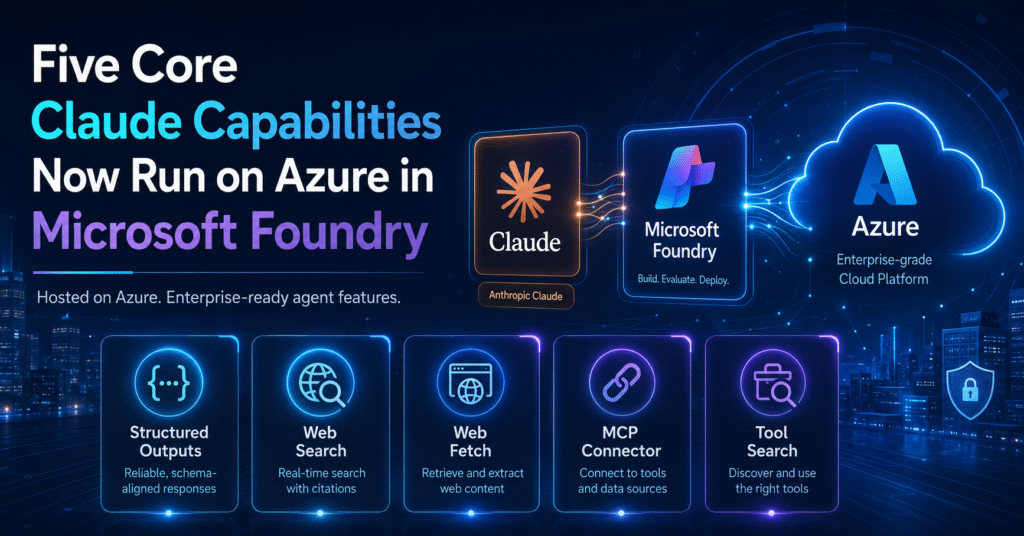
1. Microsoft Foundry Expands Claude With Five Agentic Capabilities
Microsoft Foundry has added five major capabilities to Claude deployments hosted on Azure: Structured Outputs, Web Search, Web Fetch, MCP Connector, and Tool Search. Each capability solves a different problem that developers commonly encounter when building AI-powered applications and agents.
The importance of this release becomes clearer when the features are considered together. An AI agent may need to find current information online, retrieve the contents of a webpage, connect to an internal business application, select the appropriate tool, and finally return the result in a predictable format. These new capabilities provide developers with several of those building blocks directly through Microsoft Foundry rather than requiring them to engineer every component independently.
Also Read this : Google Adds Gemini AI Voice to Gmail, Docs & Keep: Everything You Need to Know
2. Structured Outputs Improve the Reliability of Claude Responses
One of the biggest challenges when integrating large language models into software applications is getting consistently structured responses. A developer may ask an AI model to return JSON, but even a small formatting problem can cause downstream software to fail. This often leads developers to implement validation systems, retry mechanisms, and additional prompts to correct malformed responses.
Microsoft’s Structured Outputs capability addresses this issue by allowing developers to define the expected response structure using a JSON Schema. Claude can then generate output according to that predefined structure. The capability also supports strict tool use, helping ensure that inputs supplied to functions follow the required schema.
This can be valuable for applications that automatically extract information from documents, classify data, process customer requests, or transfer AI-generated information into databases. Instead of treating every model response as unpredictable text, developers can establish a clear contract between Claude and the software that consumes its output.
3. Web Search Allows Claude Agents to Find Current Information
AI models are powerful knowledge systems, but many applications require information that changes frequently. News, market conditions, product updates, company information, documentation, and other online data can change after a model’s training data was created. Web Search gives Claude-powered applications a way to retrieve current information from the internet.
This opens the door to more useful research and information-gathering agents. For example, an enterprise AI assistant could receive a research question, search relevant websites, collect information, and use those results as part of its final response. Instead of forcing developers to create their own search infrastructure, web discovery can become part of the agent’s workflow.
For businesses, this could be useful for competitive research, market intelligence, monitoring industry developments, customer research, and other workflows where relying exclusively on a model’s existing knowledge may not be sufficient.
4. Web Fetch Helps Claude Analyze Specific Websites and Documents
While Web Search focuses on finding relevant information, Web Fetch is designed to retrieve content from a specific web address. This distinction is important for AI agents because discovering a source and actually processing its contents are two different tasks.
For example, an agent might find a company’s official policy page through search and then need to retrieve the complete page to answer a question accurately. Web Fetch provides the mechanism for bringing that online content into the AI workflow. Microsoft also describes controls for managing content size and restricting which domains can be accessed.
These controls can be especially important for enterprise deployments. When AI agents consume external websites, developers need to consider security, content quality, and potential prompt-injection risks. Domain restrictions and other controls can therefore become an important part of designing a safer web-enabled AI agent.
5. MCP Connector Makes It Easier to Connect Claude With External Systems
Another major addition is the MCP Connector. MCP, or Model Context Protocol, provides a standardized approach for connecting AI systems with external tools and services. Microsoft highlights enterprise examples such as Jira, ServiceNow, Confluence, and internal APIs.
This can significantly simplify the process of creating AI agents that need to interact with existing business infrastructure. Instead of developing a completely different integration mechanism for every application, organizations can use MCP servers to expose tools and information to Claude.
The potential impact is particularly strong for enterprises that already have MCP-based integrations. An AI agent could potentially retrieve information from internal systems, perform actions through approved tools, and combine that information with other sources. This moves Claude beyond a question-and-answer interface and toward a system capable of participating in real business workflows.
6. Tool Search Helps AI Agents Work With Large Numbers of Tools
As AI agents become more sophisticated, they often gain access to an increasing number of tools. A simple assistant may only have a few functions available, but an enterprise agent could eventually have access to dozens or even hundreds of tools. Providing every tool definition to the model at once can increase context usage and make tool selection more difficult.
Tool Search is designed to help solve this problem by allowing agents to discover relevant tools when they need them. Microsoft specifically positions the capability as useful for scenarios where an agent has a large collection of available tools.
This can make large agentic systems easier to manage. Instead of expecting an AI model to navigate an enormous list of tools every time it receives a request, the system can help identify the tools relevant to the task. For developers, this could lead to more scalable agent architectures and potentially better tool-selection performance.
7. These Features Move Claude From a Model to an Agent Platform
The broader significance of the Microsoft Foundry announcement is that it is not simply about adding five individual features. Together, they provide several components required to build more capable AI agents.
Consider an enterprise research assistant as an example. The agent could use Web Search to discover relevant sources, Web Fetch to retrieve information from specific pages, MCP Connector to access internal company systems, and Tool Search to identify the appropriate business tools. Once the work is completed, Structured Outputs could ensure that the final result follows a predefined format.
This type of workflow is considerably different from a traditional chatbot. Instead of receiving a question and simply generating text, the AI can participate in a sequence of information retrieval, tool selection, data processing, and structured output generation. That is one of the key characteristics of the emerging agentic AI model.
8. Why the Update Matters for Enterprise AI
Enterprise organizations have different requirements from individual AI users. Businesses often need reliable outputs, controlled access to data, integration with existing software, security policies, and predictable infrastructure. Microsoft’s expansion of Claude capabilities in Foundry is aimed at addressing some of these requirements within an Azure environment.
Microsoft says Claude models became generally available in Microsoft Foundry in June 2026, bringing Azure-native endpoints, Entra ID authentication, Azure Marketplace billing, and Azure integration. The latest capabilities add important agent functionality to those deployments. Microsoft also describes Azure-hosted Claude deployments as keeping prompts and completions within Azure, while noting specific exceptions involving usage metadata and content flagged by Anthropic’s safety systems.
For organizations working with sensitive or regulated workloads, these deployment and data-handling considerations can be important. Microsoft also highlights a US Data Zone Standard option for workloads requiring inference within the United States. As with any enterprise AI deployment, companies should evaluate their own security, compliance, data residency, and governance requirements before choosing an architecture.
What Does Microsoft’s Claude Update Mean for AI Agents?
The latest Microsoft Foundry update reflects a broader change in the AI industry. Developers are increasingly moving away from applications that simply generate text and toward systems that can reason, retrieve information, use tools, and complete multi-step tasks.
For this transition to work at scale, developers need more than a powerful language model. They need reliable output formats, access to current information, connections to business systems, and mechanisms for managing large tool ecosystems. The five new Claude capabilities address several of these requirements.
This also changes the role of the AI platform itself. Instead of developers building every piece of supporting infrastructure around a model, platforms such as Microsoft Foundry can provide more of the underlying capabilities. That allows engineering teams to spend more time developing business-specific functionality instead of repeatedly solving the same infrastructure problems.
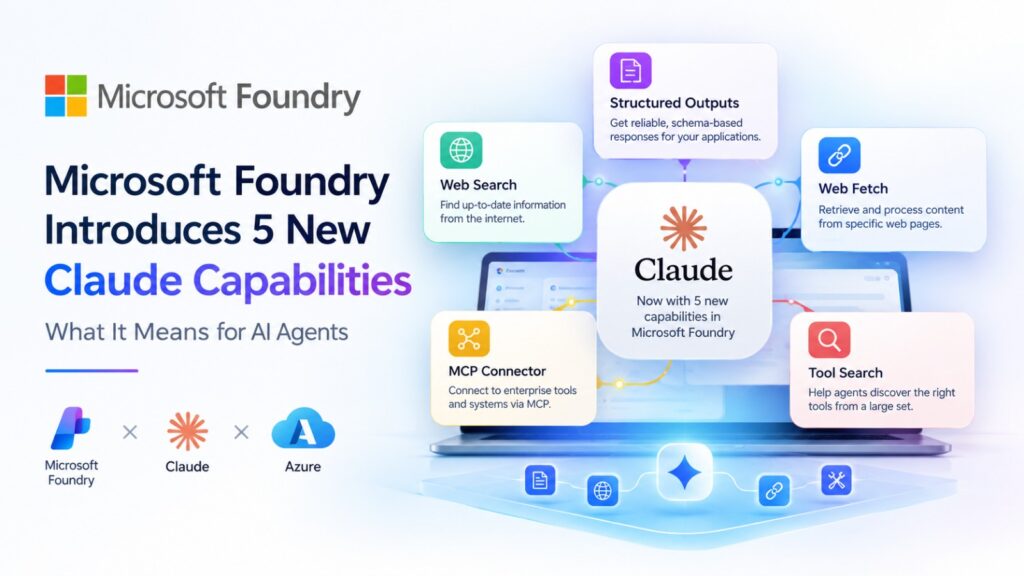
Who Can Benefit From These New Claude Capabilities?
The update is particularly relevant to developers and organizations building enterprise AI agents, research assistants, automation systems, customer-service applications, document-processing workflows, and internal business assistants.
Teams dealing with structured data can benefit from Structured Outputs. Research-heavy applications can make use of Web Search and Web Fetch. Organizations with existing MCP infrastructure can use the MCP Connector to connect Claude with enterprise tools. Meanwhile, teams building large-scale agents with many integrations can benefit from Tool Search.
The most interesting possibilities may come from combining several capabilities rather than using them independently. A single AI agent could potentially search the internet, retrieve online information, access internal company data, select a specialized business tool, and return a structured response as part of one workflow.
Final Thoughts
Microsoft Foundry’s latest Claude update is an important development for organizations building production AI agents. The five new capabilities—Structured Outputs, Web Search, Web Fetch, MCP Connector, and Tool Search—address different technical challenges that appear when AI moves from simple conversations into real-world software and business workflows.
The biggest takeaway is that AI development is increasingly becoming about more than the model itself. A capable agent needs access to information, tools, structured interfaces, and enterprise systems. By bringing these capabilities into Microsoft Foundry for Claude deployments hosted on Azure, Microsoft is making it easier for developers to build AI applications that can do more than answer questions—they can retrieve information, interact with systems, select tools, and participate in multi-step workflows.
As enterprises continue experimenting with agentic AI, features like these could become increasingly important. The future of enterprise AI is likely to involve systems that combine powerful models with reliable tools, current information, structured data, and controlled access to business infrastructure. Microsoft Foundry’s latest Claude capabilities are another step in that direction.
What are the five new Claude capabilities in Microsoft Foundry?
The five new capabilities are Structured Outputs, Web Search, Web Fetch, MCP Connector, and Tool Search. They are designed to help developers build more capable and production-ready AI agents using Claude models hosted on Azure through Microsoft Foundry.
What is Structured Outputs in Claude?
Structured Outputs allows developers to define the expected format of Claude’s responses using a JSON Schema. This helps applications receive predictable, schema-compliant information instead of relying on manually validated free-form responses.
What is the MCP Connector in Microsoft Foundry?
The MCP Connector enables Claude applications to connect with MCP servers and external tools. This can allow AI agents to work with enterprise systems and internal APIs without requiring developers to build a completely separate integration approach for every service.